ADHD and Home Clutter: How to Organize Without Shame
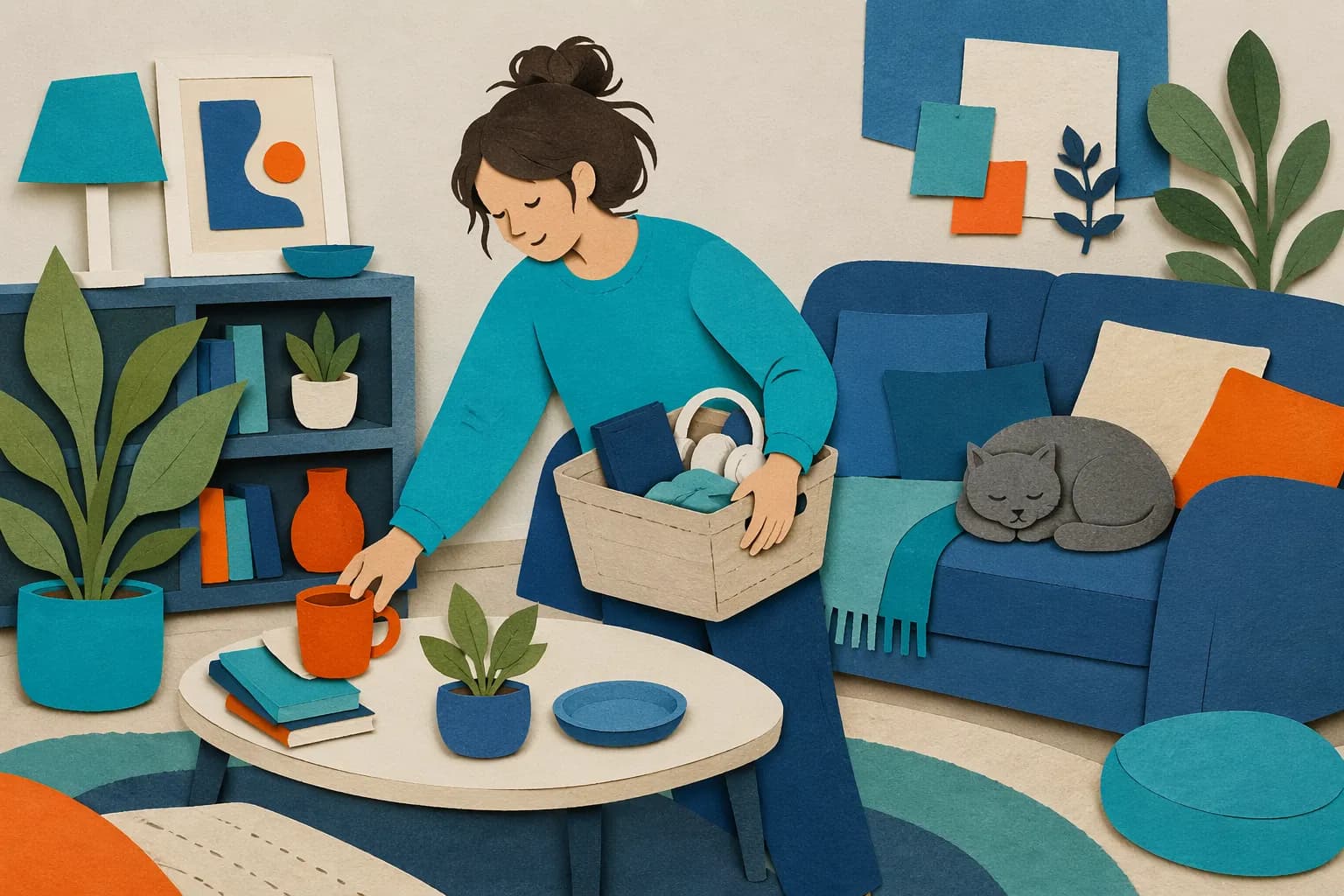
A mug left on the coffee table, two bags by the door, laundry draped over a chair, a bill tucked away "just for now" — and that familiar jolt of anxiety when someone texts they're on their way over. ADHD and home clutter rarely start with a lack of desire to tidy up. They usually start with too many micro-decisions happening at once, objects disappearing out of sight, and a kind of exhaustion that turns putting one thing away into its own separate project.
That distinction matters. If you've spent years hearing that you just need to "be more organized" or "put things back when you're done," it's easy to start treating clutter as proof of personal failure. But the problem usually has nothing to do with character or willpower. It comes down to the fact that most organizing advice is designed for a brain that can maintain routines without effort, filter out irrelevant stimuli, and hold tasks in mind even when they're no longer interesting.
ADHD and Home Clutter: Why Classic Advice Doesn't Work
The most popular cleaning advice rests on a single assumption: if you build a good system, you'll repeat it automatically. For some people, that works. With ADHD, it's the second step — the repeating — that tends to break down. A 2020 study by Guillaume Durand and colleagues found that adults with ADHD don't necessarily lack organizational strategies; what they struggle with is applying those strategies consistently over time.
"Individuals with ADHD were able to generate effective strategies, but had difficulties in consistently implementing them." — Durand et al., PeerJ (2020)
That's why the perfect planner, labeled bins, and a five-category drawer system can work brilliantly for three days and then quietly disappear. The issue isn't ignorance about tidiness — it's cognitive load: you have to remember, decide, start, finish, and then do it all again tomorrow.
Decision fatigue makes it worse. Every object asks a question: Where does this go? Should I toss it? Will I need it next week? Should I start with the kitchen, the laundry, or that message I still need to answer? The more questions your home asks of you, the easier it is to freeze up rather than act.
Shame Grows Faster Than the Pile of Clothes
Clutter with ADHD isn't just a logistical problem — it's often a source of low-grade, persistent tension. Labels like "lazy," "scattered," or "out of control" tend to accumulate alongside the mess itself. When you hear them long enough, you start cleaning not to feel better, but to earn the right to feel okay.
That usually makes things worse. Shame raises the activation threshold. When the thought is "I need to deal with the entire apartment or I'm a disaster," the task is already too big before you've lifted a finger. What follows is paralysis — or a hyperfocused sprint on one detail that doesn't actually move the needle on the broader problem.
A home that supports ADHD doesn't need to look perfect. It needs to reduce friction. That shift in framing genuinely changes how you approach the space. You're not building a magazine-ready kitchen — you're building an environment where it's easier to find your keys, set the mug down in the right place, and start the day without already feeling like you've lost.
If this pattern of clutter, avoidance, and shame has been part of your life for years, it may be worth looking at the bigger picture. You can take a free ADHD test online to see whether difficulties with organization fit into a larger pattern.
Do you have ADHD?
Quick online assessment based on the latest research
A Home That Reminds, Not Hides
One of the most common ADHD challenges is that things hidden away stop existing. This isn't a quirk — it's a natural result of how attention, working memory, and the need for external cues interact. That's why many people with ADHD instinctively leave things out in the open, even when it looks chaotic from the outside.
Rather than fighting that tendency, it's worth working with it. Visibility is often functional. An open laundry basket works better than a beautiful lidded hamper tucked in the closet. A clear pill organizer on the counter works better than an elegant box you forget about for a week. A hook by the door works better than a designated key spot in the third drawer.
That doesn't mean everything should be everywhere. The more useful question is: what needs to stay visible to support action, and what should be stored away to reduce visual noise? For many people, a workable rule is: daily-use items out in the open, occasional items stored — but in simple categories, not five levels of subcategories.
CHADD recommends open containers, baskets, and bins for similar items precisely because they shorten the distance between "I have something in my hand" and "I've put it where it belongs." That gap is where ADHD systems most often fall apart.
Minimum Tidy Zones Instead of Perfect Systems
When you try to organize the whole apartment at once, your brain registers: massive project, reward deferred, starting point unclear. That's why thinking in minimal zones tends to work better — not "I'm cleaning the house," but "I'm maintaining a few spots that keep the day running."
Three types of zones are especially useful:
The Entry Zone
This is where keys, bags, headphones, documents, and everything that tends to vanish five minutes before you leave the house belongs. Simplicity is the goal: a hook, a tray, a basket, one organizer. The fewer decisions you make at the door, the less chaos you carry into the morning.
The Quick-Drop Zone
This is a basket or open container in the living room, bedroom, or kitchen for items that don't have a permanent home yet — or that belong to a loose category. It sounds unambitious, and that's exactly the point. A basket you actually use beats a perfect system you don't. Sorting through it once every few days is far easier than deciding the fate of every object every single evening.
The Visual Relief Zone
This is one small spot that looks reasonably calm, even when the rest of the apartment is mid-process. It might be a corner of the counter, a nightstand, or one end of the couch. It doesn't fix the whole home — it gives your nervous system a signal that not everything is falling apart at once. For many people, this matters more than overall tidiness.
If you want to work on daily functioning more broadly, the articles on living with ADHD as an adult and ADHD and procrastination pair well with this one — home clutter and task avoidance are closely linked.
The 10-Minute Reset That You Can Actually Do
Big clean-up sessions sound appealing. In practice, short, repeated resets are what actually change a space over time. A 10-minute reset isn't meant to make the apartment perfect — it's meant to restore a sense of manageability.
The simplest version: set a timer for 10 minutes and do only three things, always in the same order. For example: trash, dishes, things on the floor. Or: counter, laundry, entry zone. That's it. No adding tasks mid-way. No opening new fronts.
This matters because the ADHD brain can easily fall into the trap of "since I've already started, I might as well reorganize the whole closet." That burst of energy sometimes feels satisfying — but the next day it leaves more exhaustion than a calm 10-minute reset would have. The reset is meant to be short, repetitive, and a little boring. That's exactly why it works.
You can add scaffolding if it helps: the same playlist, the same time of day, a checklist on the fridge, or a rule like "I don't carry anything to another room without a basket." The goal isn't military discipline — it's lowering the activation threshold. A well-designed reset should be small enough to pull off on a bad day.
It's also worth noting that everyday messiness and hoarding disorder are not the same thing. A 2022 study by Sharon Morein-Zamir and colleagues found that clinically significant hoarding symptoms occurred in about 20% of adults with ADHD, compared to 2% in a control group — with the strongest link to inattention. That doesn't mean every cluttered home is a hoarding problem, but if discarding things triggers intense anxiety and is genuinely blocking daily life, professional support is a reasonable and worthwhile step.
FAQ — Common Questions About ADHD and Home Clutter
Do people with ADHD just prefer living in clutter?
Not exactly. Some people genuinely function better with visible, accessible items around them — but that's usually about keeping things in sight and minimizing steps, not about chaos itself. When clutter starts interfering with daily life, it's not a personal style choice; it's a signal that the current setup is too effortful to maintain.
How do I start cleaning when the whole apartment feels overwhelming?
Start with one small zone and one short timer — 10 minutes is plenty. Pick a category rather than a whole room: just trash, just dishes, or just things off the floor. The goal isn't to finish everything — it's to get moving without hitting the overload threshold.
Are open bins better than closed cupboards for ADHD?
Very often, yes — especially for everyday items. Open or transparent containers increase visibility and reduce the number of steps needed to put something away. Closed storage can work well for things you use rarely, but in daily life it tends to lose out to friction.
When does clutter with ADHD warrant professional support?
When it regularly prevents you from sleeping, cooking, working, having people over, or when the thought of discarding things triggers intense anxiety. It's also worth speaking to someone if you notice clutter intersecting with depression, burnout, or persistent shame. You don't have to get your home in order before asking for help.
Summary: ADHD and Home Clutter — Key Takeaways
ADHD and home clutter are rarely a story about laziness — they're a story about friction, visibility, and decision overload. What helps most is not a perfect system, but one that shortens the path between noticing an object and putting it in a sensible place. A few minimal zones and a consistent 10-minute reset can do more for daily functioning than any elaborate organizational scheme. And if clutter has long felt like just one piece of a bigger puzzle, it may be worth exploring whether attention deficit hyperactivity disorder is part of the picture.
Sources
- Reduced organizational skills in adults with ADHD are due to deficits in persistence, not in strategies — Guillaume Durand et al., PeerJ, 2020. https://pubmed.ncbi.nlm.nih.gov/33194353/
- Elevated levels of hoarding in ADHD: A special link with inattention — Sharon Morein-Zamir et al., Journal of Psychiatric Research, 2022. https://pubmed.ncbi.nlm.nih.gov/34923357/
- Organizing the Home and Office Space — CHADD, 2025. https://chadd.org/for-adults/organizing-the-home-and-office-space/
- Attention deficit hyperactivity disorder: diagnosis and management, recommendations — NICE, 2018. https://www.nice.org.uk/guidance/ng87/chapter/recommendations
- A Guide for ADHD Adults / Making Peace With Your Clutter — ADDitude, 2024. https://www.additudemag.com/making-peace-with-your-clutter/